

Saros PS5 Humble Review: The Returnal Successor That Actually Fixes Everything

Before 2021, studio Housemarque was synonymous with modest, top-down arcade bullet-hell shooters. Then came Returnal, which shifted their philosophy into third-person, added a roguelike structure, and became one of the most acclaimed PlayStation exclusives of its generation. Yet every cult hit has its vocal minority. The complaints were clear: Returnal was a genuinely demanding game, it didn't respect the player's time, and every return to square one after death was painful.
Saros is a direct answer to those complaints. Housemarque set itself a formidable challenge: create a spiritual successor that is considerably more accessible without losing the distinctive identity established in Returnal. Did they succeed? Absolutely.
In a mood, something, erm, well, completely similar? Check out our Replaced Review!
MADNESS, EVERYONE IS ON EDGE, Story and Atmosphere of Saros
If you enjoyed the way Returnal built its atmosphere through the psychological torment of a single character, Saros transfers that sensibility to an entire crew. The premise, on paper, is a proper sci-fi classic: the powerful, ruthless corporation Soltari has set its sights on the planet Carcosa, rich in a valuable substance called Lucenite. After three consecutive expeditions lost contact with Earth, you step onto the scene.

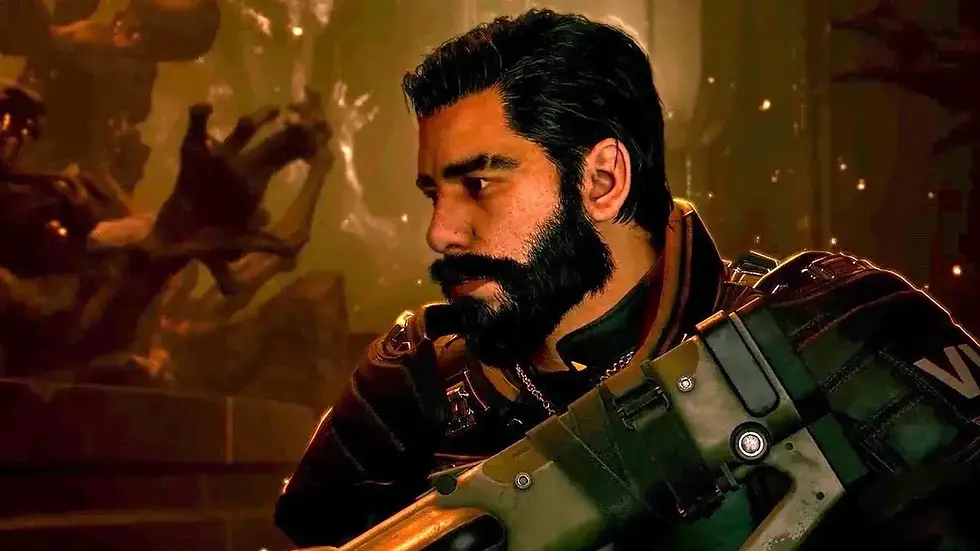
You step into the boots of Arjun Devraj, a Soltari soldier from the latest expedition. His task is simple: ensure mining operations continue at all costs and discover what's happening on the planet. The story turns personal because someone close to him was in one of the missing expeditions.
Unlike Selene in Returnal, Devraj is not alone. The ship's remaining crew stays in a central area you return to between attempts, shifting the game's tone from Returnal.
The dynamics among people who find themselves in a completely impossible situation, far from home, surrounded by something they don't understand, are written with the awareness that these characters don't need to be likable to be convincing. With solid voice acting, each has their own recognizable personality traits, their own version of anxiety, their own personal threshold of tolerance, and the game plays with what happens when the planet's madness starts seeping under their skin.
Beneath all that interpersonal drama, however, lies a mystery that is the real engine of the story. Who built the grand temples and architecture that Devraj finds across Carcosa? Where did the previous expeditions disappear to? And what, exactly, are the creatures that walk the planet as though it were always destined to be theirs? The game doles out those answers slowly, mostly sensibly holding its biggest cards back for the finale, and part of it lies behind a secret ending that will push you to dig a little deeper.
Who Is Saros for?
Housemarque advertised Saros as a game built for half-hour bite-sized sessions, and in terms of gameplay, that is absolutely true. However, I can honestly say that the story drove that roguelite "just one more run" reflex in me just as much as the action did. Maybe this time I'll get a corridor further. Maybe one of the written logs will finally clarify what's happening to these people.
That said, what the game explicitly serves up through cutscenes and the bulk of character dialogue isn't the most straightforward. Housemarque had ambitions to tell a layered, symbolically charged story, so many of the key moments are conveyed through a visual language that YouTubers will be dissecting for months. At the same time, some of the most concrete revelations await you in text logs scattered across the planet. This isn't necessarily a problem, but know that skipping written and audio logs means you're missing a significant part of what makes the story feel complete.
What makes Saros particularly surprising is how deftly it weaves its thematic interests beneath a genre surface. Returnal was, beneath its sci-fi trappings, primarily a psychological thriller. Saros is, on the surface and below it, cosmic horror in the finest sense, a game about greed, about forces we don't understand and that don't want to understand us, about civilizations that were already there and fell. But through its characters and their fates, it engages just as seriously with corporate greed, betrayal, and the fragility of human relationships when things go downhill.
JUST… ONE… MORE… RUN, Gameplay and Mechanics
Saros, like Returnal, is a game where you play from a third-person perspective, run around, dodge so-called bullet-hell showers of projectiles, and shoot everything that moves. The levels on Carcosa, despite their visual openness, are relatively linear; don't expect an open world or Metroidvania-style exploration. Nevertheless, almost every segment has side paths you can peek into for temporary upgrades, resources, and those text logs. The main route is always clear, but the game actively incentivizes you to explore those optional sections.
Mechanically, the combat and movement are polished to the same level as Returnal, or even one step beyond it. Devraj's animations are snappy and precise, his movement fluid, agile, and responsive. You have a short and a long dash, a shorter and a longer jump, and everything fits into one fluid choreography that keeps getting better as you get better.
The gunplay is equally satisfying. Beyond the visual spectacle of the shooting itself, the adaptive triggers do excellent work here; every bullet fired is palpably felt, and you definitely don't have the sense of shooting into empty pixels. The weapons are diverse: pistols, various rifles, shotguns, crossbows, and special attacks that can devastate enemies. Every weapon has an alternate fire mode triggered via the adaptive trigger.
They lack balance; however, the game is considerably easier or harder depending on what you happen to pick up in a given run. Shotguns, for example, I regularly avoided like the plague, because no matter how powerful they sound on paper, Saros's levels often feature so many flying or distant enemies that short-range weapons become almost counterproductive. Crossbows have impressive range and power, but fire slowly, so they pale next to rifles, especially those whose bullets automatically track enemies, which is a huge advantage given the intensity of the action and the mechanics you need to juggle.

An important distinction for experienced players is that Returnal was a pure roguelike, while Saros is a roguelite. In a roguelike structure, you lose almost everything on death and start from scratch. In a roguelite, the resources you gather in a run remain yours. Here, those are specifically Lucenite and Halcyon, which you then spend in a system that's a variation on a classic upgrade tree. You boost active abilities, resistance to enemy attacks, shield capacity, the amount of resources enemies drop on death, the starting level of weapons in subsequent runs, and more.
This alone makes the game considerably easier, because you're not solely dependent on your own skill; you can smooth the path with statistical improvements that can and often do mean the difference between triumph and a return to the starting point. But Housemarque decided to beef up that progression layer with a range of systems to make the game more accessible to newcomers and those frustrated by Returnal's structure.
ACCESSIBILITY OPTIONS AND DIFFICULTY SYSTEMS Of Saros
First, alongside classic dodge-based avoidance, the game gives you a shield as a defensive tool that significantly changes how you approach encounters. Projectiles in Saros come in multiple colors, and due to the intensity of the action, you need to read them almost intuitively. Certain types of projectiles the shield absorbs, and in doing so, fills your energy for a special attack. Others you must dodge because the shield doesn't stop them. And others you can parry, returning them to the sender with timely shield activation.
Parrying is convincingly the least useful action, or at least extremely situational. The action can at times be so frantic, and attacks come from so many directions that it's rare to be facing a specific enemy exactly when they fire that particular type of projectile, allowing you the luxury of concentration to react at the right moment. Parrying is most useful against boss enemies, and exclusively so because those are the rare occasions where you face one opponent at a time. Despite that, the shield as a whole is a welcome addition that turns the game's philosophy on its head: instead of running away from projectiles the entire time, Saros asks you to consciously step into them and tactically decide which ones you absorb, which ones you dodge, and which ones you send back. This new dimension makes the game feel deeper to the point that Returnal feels slightly sparse by comparison.
Second, you have something called Carcosan Modifiers, a clever system that works like a seesaw. Want to make the game harder? Insert modifiers that are negative for you: they strengthen enemies, degrade your weapons, or even disable certain abilities. Want to make it easier? Insert modifiers with positive effects. At the core of the system, you're expected to balance them, one positive, one negative, and that, to my taste, is the best way to play. However, the game's menu allows you to enable an option where positive modifiers can be inserted without balancing them with negative ones, meaning you can practically stroll through Saros and focus only on the narrative. Personally, I see that more as an accessibility option than an integral part of the experience. In the same spirit, it's possible to additionally adjust how much the game assists with aiming.
Third, you have the option to unlock the Second Chance ability, which, once per run, will automatically revive you when you die. This, parrying, and some other life-easing things need to be unlocked through the skill tree, and in that sense, the game has a beautifully tuned progression that constantly pushes you to accomplish something in order to get a tool that will help you accomplish something even bigger. But to keep you from getting too spoiled, the deepest branches of the upgrade tree are locked until you defeat specific boss enemies. In other words, the game won't let you buy your way through content with upgrades; it requires you to prove at least a minimum of skill to unlock the next level of progress.
Fourth, and perhaps what reduces the anxiety of playing most, is that each biome is a smaller, more digestible chunk, and once you've unlocked it, you can freely teleport to it. Gone are those frustrations where a cruel encounter kills you the moment you've reduced a boss to the last 20% of its health, forcing you to spend the next 20 minutes trudging through already-cleared corridors just to get back to where you were. Add to that auto-save, multiple save slots, and the Suspend Cycle that lets you pause a run for a day or two, and it's clear Housemarque was listening to what the audience had to say about Returnal's relationship with player time.
Saros Enemy Design And Boss Fights
Each level brings its own gallery of enemies, and the game combines them with conductor-like malice. Just when you've gotten used to the stationary turrets, ones with shields appear that you need to physically hit to break them down. Just when you've resolved that, flying enemies arrive to harass you from above. Then the flying ones start appearing in variants with accompanying projectiles, and then come beasts that actively hunt you and leap around the level after you. The game never lets you get comfortable, and that's precisely what hits that feeling of fluid rhythm that Housemarque does best. Crucially, the game gives you the tools alongside that pressure, so you practically never feel outmatched, just momentarily caught off guard.

The bosses are a small culmination of each level and among the best-designed things in the game. But it's worth noting that their difficulty curve is not linear. The first one gave me just the right amount of trouble for a first boss in a roguelite. The second, I defeated on the first attempt, practically on autopilot. The third gave me trouble again. And then a combination of Carcosan modifiers and ever-improving upgrades carried me almost to the very end of the game without any serious obstacles.
THE ECLIPSE MECHANIC, Risk and Reward
There is one more significant mechanic: the solar eclipse, which the player manually triggers and alters the game's rules. The level geometry shifts, enemies become more aggressive and gain an entirely new palette of attacks, new types of projectiles are introduced that the shield cannot absorb, and as a reward, the game noticeably increases the amount of Lucenite enemies drop on death. There are sections where activating the eclipse is necessary for progression, but later, it is more often purely an optional, high-risk, high-reward mechanic.
LOVECRAFT CALLED, HE WANTS HIS ATMOSPHERE BACK, Visuals and Sound
If you enjoyed Returnal's atmosphere, I can almost guarantee Saros will have the same effect. Aesthetically, this is one of the most striking games I've seen in the past few years, not because of raw graphical resolution (which is outstanding) but because of its stylistic approach. A whiff of H.R. Giger is visible in the organic, bone-mechanical forms of the enemies and in that biological-industrial architecture that looks as though it was made from an engineer's bad dream
.
The influence of Lovecraft is also evident, with ancient places and beings whose nature you cannot comprehend, whose very proximity gnaws at your psyche. Combine that with vegetation the color of clotted blood, monumental stone architecture that looks as though it has stood there for all eternity, and celestial bodies that don't behave as they should, and you get a world that is ominous from the first second to the last. We have aptly used our XP-Panther cosmic headset to fully immerse ourselves in this amazing game.
Fans of cosmic horror in the narrower sense will feel right at home here, but Saros is not a game that tries to be scary; it is more unsettling, and in that it succeeds far better than most titles that explicitly deal with the theme. The sound design contributes significantly, as does the soundtrack signed by Sam Slater (Chornobyl, Joker), which won't let you relax even when things are going well, with those deep mechanical drones and alien melodies that sound as if they come from another universe entirely.
The interface follows a minimalist aesthetic, emphasizing clarity and the exact right amount of information. At no point did I feel lost, and if something is unclear, tutorials are always available in the menu, divided by category.
Technically, I played on a standard PlayStation 5, and I can tell you that Saros runs as smoothly as if it were built for that hardware. There's no choice between fidelity and performance modes here; the game runs at 4K and 60 FPS as standard. There are virtually no stutters or frame-rate drops, even when the screen is flooded with projectiles and effects. For that level of visual density and technical stability, this is nothing short of impressive. With this game, every PlayStation 5 is effectively a "Pro."
Saros In Conclusion
Saros is one of those rare, triumphant examples where a spiritual successor truly surpasses the original. Housemarque carefully listened to every criticism leveled at Returnal, from the at-times merciless difficulty and lack of permanent progression, to the rigid structure that didn't respect player time, and responded to all of it with the most elegant design solutions possible. In doing so, they didn't dilute what made their previous hit special. This is still a relentless bullet-hell that demands your complete focus, but it now finally gives you the tools to dictate the terms of your own survival.
The game is not without its small niggles, but they are negligible, because once it clicks, it stays with you as a unique title whose blend of anxious atmosphere and raw mechanical pleasure has few rivals. That feeling of absolute fluidity, when muscle memory, reading the combat chaos, and tactical decisions merge into one perfect, instinctive dance through bullets, is entirely incomparable. Housemarque here didn't risk a revolution; they delivered a masterful evolution of their own recipe. The result is a title that will be played and remembered long after most of this year's disposable blockbusters have been forgotten.
GAME RATING:9.2 / 10
Saros earns a 9.2 because it delivers a masterful roguelite evolution of Returnal's formula, refining every rough edge with smart accessibility systems, a genuinely unsettling atmosphere, and flawless PS5 performance, with only minor weapon-balance inconsistencies and an uneven boss difficulty curve holding it just short of a perfect score.
AGE RECOMMENDATION:16+
Saros contains no explicit gore or sexual content, but features intense, sustained combat violence, deeply disturbing cosmic-horror imagery (grotesque creature designs, oppressive alien environments), and heavy thematic content dealing with corporate exploitation, psychological deterioration, and existential dread. A PEGI 16 classification would be appropriate. Younger teens (13–15) who are experienced action game players and whose parents are comfortable with mature atmospheric horror could potentially engage with it, but the tone is relentlessly dark, and the content is not designed with younger audiences in mind at any point.
GEMINI AI SUMMARY
Saros is a PlayStation 5 exclusive developed by Housemarque, serving as a spiritual successor to Returnal. Where Returnal was a pure roguelike, Saros adopts a roguelite structure — meaning resources and upgrades persist between runs — making it significantly more accessible without sacrificing the studio's trademark bullet-hell intensity. Players control Arjun Devraj, a soldier sent to the hostile planet Carcosa on behalf of a ruthless corporation, accompanied by a crew whose psychological unraveling forms the emotional backbone of the narrative. The story explores themes of cosmic horror, corporate greed, and human fragility through a combination of cutscenes, environmental storytelling, and scattered text logs.
Mechanically, Saros introduces a color-coded shield system that adds a new layer of tactical depth, requiring players to absorb, dodge, or parry incoming projectiles in real time. A Carcosan Modifiers system allows voluntary difficulty adjustment in either direction, and a manual eclipse mechanic offers a high-risk, high-reward mode that alters enemy behavior and level geometry. Boss encounters are inventive but suffer from an uneven difficulty curve. Weapon variety is strong, though balance is inconsistent in practice. The game runs at native 4K and a locked 60 FPS on standard PS5 hardware with no performance mode toggle required. Visually and sonically, Saros draws heavily on H.R. Giger aesthetics and Lovecraftian dread, backed by a score from Sam Slater. The reviewer awarded it a near-perfect 9.2 out of 10, calling it a masterful evolution of Housemarque's own formula and a title that will outlast most of 2025's bigger releases.