

60 Creatures, Zero Lives Lost: Why Yoshi and the Mysterious Book Is Perfect for Young Gamers

Dinosaurs aren’t really my area of expertise. Even as a kid I was always more into Ninja Turt... Erm, I mean Hero turtles and robots and Gargoyles rather than dinosaurs. But Yoshi has always stood out for me, thanks to one of the best platformers on the Super Nintendo, Yoshi’s Island. It left me with warm memories due to its unique charm and platforming challenge. Now, with Yoshi and the Mysterious Book, I jumped in curious: can this new game offer the same magic, especially for younger gamers?
Let me reveal something right at the start: Yoshi and the Mysterious Book, while appearing to be a platformer, actually has a different core focus. Unlike Yoshi’s Island, this game shifts attention to exploration, puzzle-solving, and creature discovery instead of challenging platforming. If you want another platforming masterpiece, this isn’t it. Once I separated it from the series’ usual style, I found that the new gameplay direction makes it especially well suited for young gamers looking for curiosity-driven adventures rather than difficult obstacles.
In the mood for something completely different? Check out our Call of the Elder Gods review!
Yoshi and the Mysterious Book Has A Simple Yet Charming Premise
The premise is actually very simple. This time, instead of baby Mario arriving on Yoshi's popular island, a mysterious talking book falls from the sky. It introduces itself as Mister Encyclopedia, or Mr. E for short, and reveals that within its pages hide wonderful creatures that have yet to be explored. The story isn't complex, but it has at least one or two moments you'll come to appreciate later in the game.
And so our bookish adventure begins. Each page contains one world, and across it, I could see various creatures freely strolling around. I'd pull out a magnifying glass, place it over a newly discovered organism, press the A button, and find myself inside a new level. The goal of each level is to learn as much as possible about the new creature inhabiting it. What happens when Yoshi swallows it, and what does it taste like? What happens when you jump on it? Can it swim in water? What if you line several of them up next to each other?
At the start of each level, you discover unique gameplay mechanics and use them to reach the main conclusion that ends the level. This is followed by recording your findings and naming the new species, with the option to use suggested names or create your own. Only after these records did I realize the game’s enormous scope for completion. No matter how thorough I was, I’d often see at the end that I had uncovered just a small fraction of what each level offers. The coins collected could be spent on hints for new discoveries.
Staggering Variety, Every Level Feels Brand New

The variety of levels is staggering. Each new life form introduces a completely new mechanic: not just different colors or minor tweaks, but genuinely distinct experiences. To illustrate, here are three of the roughly sixty creatures.
Take the level with Croakaok as an example. This is a round character with a leaf on its head. When I jumped on it, I'd bounce even higher into the air, but in the process, Croakaok would produce a sound. Naturally, croaks of different colors emit different tones, so by jumping from one to another, I could literally play the Do-Re-Mi melody and thus make a new discovery. Or feed it a nut and get a higher note. And that's just a few ideas from the 31 possible experiments the level offers.
As a second example, I can take the massive, green, grass-covered creature called Thudd. First, wake it up by jumping on its belly, then feed it to get it moving. After that, Thudd would suck me in and launch me in a desired direction so I could smash rocks along the way. A third example is the fisherman Casterway. I'd carry it on Yoshi's back and use its help to catch fish, objects, and various underwater monsters.
And those are just three examples. There are also umbrella-shaped creatures for a slower descent, bubble-blowing creatures that help you float, and a giant boar with a drill snout demolishing everything ahead. The imagination is impressive; every new level feels like a separate mini-game. I experienced no repetitiveness—just curiosity for what the next page would hold.
Yoshi and the Mysterious Book Is A Completionist's Dream (or Nightmare)
With that in mind, if you're a completionist, this could be a brutal game for you. As I already mentioned, every level hides loads of small details, and without help, exploration can take a seriously long time. Sometimes, even despite purchasing hints, I'd get stuck on certain discoveries or when looking for the hidden daisies, of which there are several in each level.
Still, I found most main discoveries easy to complete, maybe too easily. The game never made me break a sweat, not even near the end. There are no advanced platforming mechanics, and Yoshi can’t lose a life; falling just returns you to the last platform. The streamlined experience meant I missed out on a greater challenge, whether in puzzles or platforming.
Visual Style and Sound Design
From a visual standpoint, I liked the graphic style. The backgrounds look as though they were hand-drawn with watercolors, the edges of levels resemble the faded pages of a book, and the creatures themselves overflow with personality. Even the stop-motion animation of the characters added to the overall experience, because you can really feel the contrast between the dynamic environment and their specific movement style. And given the amount of effects, enemy duplication, and various mechanics, I didn't notice any significant performance drops during gameplay.
Unfortunately, that creative visual identity didn't carry over to the music, even though we played wearing our XP-Panther LED headset. Yoshi has had truly memorable melodies over the years, and that simply isn't the case here. Honestly, as I write this, I can't hum a single tune from the game, which rarely happens to me with Nintendo games.
In Conclusion
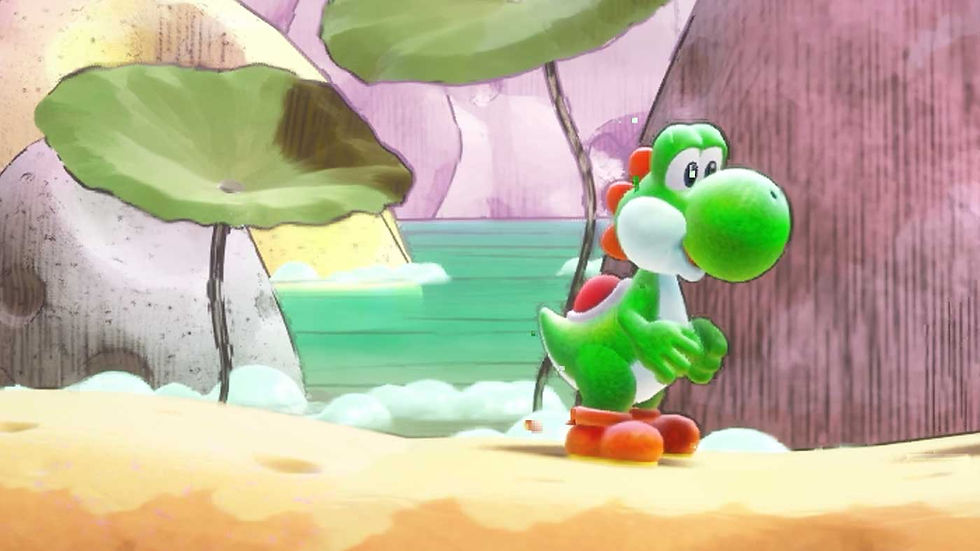
Despite its forgettable music, Yoshi and the Mysterious Book brings a genuine breath of fresh air to the series for one audience in particular: young gamers. Its picture-book visual style, consistently creative variety of gameplay, and light-hearted challenges make it an excellent choice for families and newcomers to gaming. The game’s main strength is that it replaces conventional difficulty with encouragement to explore and be curious, offering a uniquely inviting experience.
For my personal taste, the only thing missing was a little more challenge, whether through puzzles or the platforming itself. Because if that had been there, this would easily be a title I'd recommend to everyone who owns a Switch 2.
Rating
7.5 / 10, Yoshi and the Mysterious Book earns its score through extraordinary gameplay variety and a charming picture-book visual style, but is held back from greatness by a near-total absence of difficulty and music that leaves no lasting impression.
Age Recommendation
Recommended for ages 4 and up.
The game is an excellent fit for young children: Yoshi literally cannot die (falling just resets you to the last safe platform), the mechanics are introduced gently one at a time, and the creature-discovery loop is naturally curiosity-driven. Older kids (8–12) will enjoy hunting for every secret, while parents can comfortably co-play or hand the controller over without concern. There is zero violence, no scary content, and an overall tone that is warm, playful, lighthearted, and educational (naming creatures and observing how they interact with the world).
Gemini AI Summary
Yoshi and the Mysterious Book is a Nintendo Switch 2 title that leans more toward exploration and creature discovery than traditional platforming. Players help Yoshi investigate a magical talking encyclopedia called Mr. E, uncovering roughly 60 unique creatures across beautifully illustrated, picture-book-style levels. Each creature introduces a completely fresh gameplay mechanic — from musical frogs to grass-covered giants — keeping the experience consistently surprising. While the game shines visually and offers massive replay value for completionists, it lacks meaningful challenge and features forgettable music. It is, however, an ideal choice for young children and families, thanks to its inability to lose lives, gentle learning curve, and warm, imaginative tone. Score: 7.5/10.