

Replaced Review: Breathtaking Visuals, Repetitive Gameplay — A 2.5D Indie With an Identity Crisis

It's hard for me to grasp that I was still wearing a mask in public when Replaced was announced. It feels like yesterday, not five years ago! The first look at this 2.5D action title stayed etched in my memory for its fusion of a futuristic theme and retro style. At that moment, Replaced didn't look like a typical indie game to me — it felt like pushing the boundaries of independent game production. Then came numerous release delays, and in the meantime, we got other indie games that looked equally impressive.
Now that Replaced is finally here, the theme of the game is more relevant than ever before, because AI technology is increasingly leaving the realm of fiction and becoming our everyday reality. Not a day goes by without someone mentioning how we could be replaced by artificial intelligence.
In the mood for something completely different? Check out our Tomodachi Life review!.
The World of Replaced
Replaced is set in an alternate 1980s, where nuclear disasters have ravaged the entire American nation. The game depicts a world trying to piece itself back together after a complete collapse, through a system that feels controlled and somewhat artificial. Traces of the past remain, while a new power structure is being imposed through the Phoenix Corporation. It shapes everyday life in a way that isn't entirely clear, but in every segment of the environment, you can feel that the inhabitants have been put in the corporation's service.

The game begins without any introduction that would prepare the player for what follows. An accident occurs in which the artificial intelligence R.E.A.C.H. merges with a human body, becoming trapped in physical form, without any clear context or anyone to explain where it is or what is happening. From that moment, the AI protagonist finds itself in a world completely unknown to it. It is forced to flee and survive as the AI police begin hunting it down.
Story and Narrative Pacing
The story in the first half of the game unfolds quite slowly, which won't suit all players. However, that is precisely its intention: to gradually guide the player through the situation the main character finds itself in. The world is slowly revealed through written records and dialogues that build the background and context of the environment. Ultimately, the story revolves around Reach's transformation from a calculating system into a being with emotions.
On its journey, Reach meets Tempest, a young man full of ambitions and ideas for opposing the corrupt organization. He is the one through whom Reach sees what life is like for people outside the system. Through him, the contrast between the system and those outside it deepens further, and thanks to him, Reach begins to understand the human perspective and the consequences of the world he inhabits.
Visual Style and Atmosphere Of Replaced
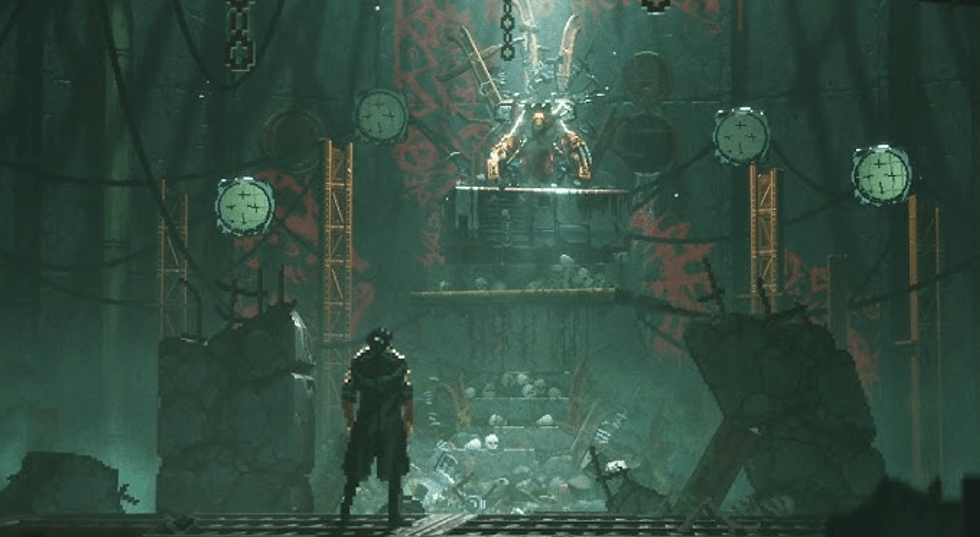
The visual style through which all of this is told is definitely Replaced's greatest strength. The world's appearance enriches every scene, and the mix of realistic 3D elements and 2D retro pixel sprites adds a special depth. Lighting plays an important role in gameplay and simultaneously shapes the gloomy, oppressive atmosphere in every frame.
The main settlement in the game feels bleak and lifeless, while Phoenix City itself, bathed in neon lights and street lighting, leaves a completely different impression. It is precisely through this contrast that the visual presentation conveys the story on its own and clearly suggests what kind of places these are, without the need for additional explanation.
Replaced is very precise in choosing the moments to pull the camera back, widen the frame, and let the space convey the mood. It is equally precise in choosing those moments to narrow the focus onto corridors, confrontations, or tense movement sequences. This further amplifies the rhythm and intensity of every scene. All of these are further enhanced by listening with our XP-Panther Blue Headset.
Combat and Gameplay Mechanics

Combat in Replaced relies on an intensely action-oriented approach, where every hit, dodge, and parry has its own weight and rhythm, much like choreographed beat-'em-up scenes in films. Dealing with enemies can, therefore, be quite satisfying.
Over time, however, the impression arises that the strong presentation also carries a certain burden of expectation. At first, everything feels fresh and exciting, but as the hours pass, the gap between what the game visually promises and what it delivers becomes increasingly noticeable. There is a natural expectation that the mechanics follow the same level of ideas and progression, but Replaced frequently falls short of any real advancement in gameplay depth.
Pacing Issues and Repetition
The bulk of the game is linear progression, with sporadic stealth segments that break the rhythm. The emphasis is clearly placed on soaking in the atmosphere and observing the surroundings, but this approach becomes monotonous over time. There is a lack of greater intensity or variety, and only near the end of the game do somewhat more dynamic elements begin to emerge.
Frustration occasionally arises in the platforming sections, mostly due to imprecise command recognition and unclear climbable surfaces. Because of this, sequences often have to be repeated through trial and error. As beautiful as Replaced looks, environmental readability is not one of its stronger points.
Throughout the story, abilities are unlocked retroactively, including the use of a pistol, a grappling hook, and various approaches to confrontations. However, the combat system brings no real surprises. There is a certain variety of enemies and a combination of moves, but it all comes down to guessing the right moments to parry attacks. An additional problem in this 16-hour adventure is that the sequences themselves are frequently repeated in the same pattern, making it feel as though they have been artificially stretched out to make the game last as long as possible.
Technical Performance of Replaced
The situation is further worsened by poorly placed checkpoints. Checkpoints are quite strict and unforgiving, which often results in losing around 15 minutes of gameplay, whether in combat or platforming sections.
I played Replaced on the PC version, which ran mostly stably, with only occasional, brief stutters outside of combat. There are very few graphical settings, which makes sense given the game's specific visual style and presentation. There are actually more visual bugs than graphical settings issues, but these are resolved by restarting the game.
In Conclusion
Replaced ultimately leaves the impression of a game that does not hide its weaknesses, but openly shows them through its own pacing and execution. The shortcomings cannot simply be ignored because they affect the rhythm of play, but at the same time, they do not diminish what the game is trying to achieve. Beneath everything, there still stands a firm vision of a game that knows exactly what kind of reaction it wants to provoke in the player through its world, even when its mechanics do not match that level of ambition.
Despite dealing with common themes such as identity, control, and survival, Replaced relies more on the believability of its environment than on direct narration. Phoenix City remains a compelling space precisely because it is experienced through the game. Still, Replaced more often dedicates itself to atmosphere than to events, and thereby occasionally slows down its own pace. The overall impression remains positive, more so as a whole than in its individual elements.
Rating: 6.5/10
Replaced is a visually stunning, atmospherically rich game that, unfortunately, can't match its breathtaking presentation with equally engaging or varied gameplay mechanics.
Age Recommendation: 16+
Replaced carries a mature tone with themes of corporate oppression, AI identity, survival in a post-apocalyptic world, and violence in combat. The beat-'em-up combat, while not excessively gory, features sustained fighting sequences. The slow-burning narrative and philosophical themes around identity and control are better suited to older teenagers and adults who can appreciate the nuance. Younger teens under 16 may find both the pacing and the subject matter either too slow or too heavy.
Gemini AI Summary
Replaced is a 2.5D action game set in an alternate 1980s post-nuclear America, following an AI called R.E.A.C.H. that becomes trapped in a human body in a corporation-controlled world. Its standout quality is exceptional visual presentation— realistic 3D environments and retro 2D pixel sprites, with masterful lighting and cinematic camera work, creating an immersive dystopian atmosphere. The low-building story is meaningful, centered on identity and systemic control, anchored by the relationship between Reach and Tempest. However,y repetitive gameplay, imprecise platforming, strict checkpoints, and limited combat progress undermine the experience. Technically stable on PC, recommended for players aged 1+e. Final score: 6.5/1.ions.